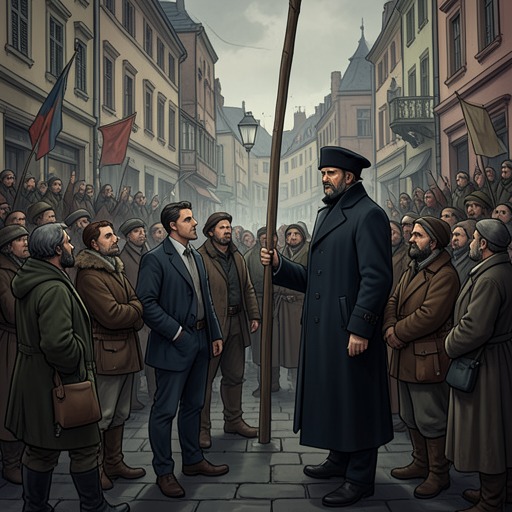
Andrei Zhivago
Doctor ZhivagoAndrei Zhivago is a millionaire whose prosperity survives in the names of businesses and objects long after the family itself has lost its former standing. A profligate father who abandons both his first and second families, he enters the novel most powerfully through the aftermath of his suicide: a stranger remembered by Misha Gordon, and the absent parent whose history Yurii Zhivago did not know while growing up.
Identity and Family
Andrei is the father of Yurii Zhivago, called Yura as a child, and of Evgraf Andreievich Zhivago, his son by Princess Stolbunova-Enrici. He is also the husband of Maria Nikolaievna Zhivago, whom he leaves behind with their son. The family’s account of his whereabouts conceals the truth: Yura is told that his father is away on business in St. Petersburg or at a large fair, often at Irbit, while Andrei is actually living a dissolute life in Siberia and abroad.
His abandonment is inseparable from the family’s former wealth. Yura remembers a time when the Zhivago name marked a factory, a bank, buildings, a necktie pin, and even a cake. The scale of that vanished world is conveyed in an image from childhood: saying the family name to a Moscow sleigh driver seemed to send the passenger toward a fairy-tale kingdom, a vast, quiet park among frosted firs. That remembered abundance stands against Andrei’s squandering of the family millions and the disorder he leaves in his wake.
The Train Journey and Suicide
Andrei’s final appearance is recounted through Misha Gordon’s memory of a long train journey. Misha’s father describes him as a well-known millionaire, good-natured but not fully responsible for his actions. In their compartment, Andrei speaks about his son, his late wife, and the second family he has deserted, then loses the thread of his story as terror overtakes him.
He shows Misha an inexplicable affection, perhaps directed toward someone else through the boy, and repeatedly buys him presents at stations. His last gift is a small wooden box of minerals from the Urals. The gift survives the giver: after Andrei’s death, Misha sits examining it, a concrete remnant of the man whose affection and agitation had unsettled him throughout the journey.
Andrei drinks incessantly and says that he has not slept for three months; whenever he sobers up, he suffers torments he considers beyond ordinary understanding. At the end, he rushes into the compartment, takes Misha by the hand, tries and fails to say something, then runs onto the platform and throws himself from the train. The passengers are returned to their seats as officials record the death and the body is dragged up the embankment; the train then starts again, carrying Misha away from the scene.
Legacy and Narrative Role
Andrei’s suicide is first encountered as a disturbing event witnessed by Misha, but the later account of the Zhivago family gives the dead man’s conduct a larger meaning. The nervous passenger who spoke of his son and abandoned families is identified as Yurii’s father. What was hidden from Yura during his mother’s lifetime becomes legible to the reader through another child’s recollection and his father’s account.
The novel thus makes Andrei present chiefly through absence, testimony, and objects: the son who grew up without knowing he had been abandoned, the box of minerals left to Misha, and the name of a family fortune that could not be preserved. His final failed attempt to speak leaves no explanation or reconciliation; it sharpens the contrast between the wealth he squandered and the intimate history he could not bring himself to tell.